Those of you who obsessively check my Amazon and Goodreads pages (or is that just me…?) will have seen that the cover artwork for the Lindsay Harding series has recently undergone a facelift. In celebration, I’m giving away three signed copies of A Death in Duck with the older artwork (the original Doberman cover) to the first three people who post reviews of either book on Amazon. Or better yet, review both books and then post your reviews on Goodreads as well! 🙂
Once you’ve left your honest review on Amazon, post the link in the comments section below. I’m interested in your opinion–both critique and praise–so please opine freely!
If you’ve posted a review previously, THANK YOU. Just post the link to claim your free book! I’m also running this contest via my mailing list, so I’ll post updates in the comments section below as the free books are claimed.
Genevieve LaVO of LaVO Design has been working on new cover art for my books. She’s just put the finishing touches on the cover for A Murder in Mount Moriah. It won’t be officially launched for a few weeks yet, but I wanted to get some early feedback. So what do y’all think? Are you as excited as I am? Vote for your favorite:
Bestselling mystery writer Allison Janda, author of the food and photography-themed Marian Moyer cozies, debates the existence of writers block, talks about sexy food photography, and confesses to her blogging addiction.
Minty Fresh Mysteries (MFM): I love your protagonist’s profession–food and crime scene photographer–partly because it’s plausible that she would actually have access to information about murders. It drives me nuts when, say, a glassblower or a pastry chef or a friggin’ housecat ends up stumbling across piles of dead bodies everywhere she goes! How important is it to you that your stories are realistic?
Allison Janda (AJ): Originally, Marian was just going to be owner and photographer for Food Porn, but I felt like it wasn’t enough. As you said, it just wasn’t realistic for her to start suddenly getting wrapped up in these crazy crime dramas as the head of a magazine. My leading lady needed to be intelligent and savvy when solving crimes, but she needed room to grow as a character, and room to make mistakes.
That’s when my idea for a late 20-something crime scene photographer came about. I felt the age and profession would give Marian some basic insights to her work, but with room to come into her own as she continued to get better and climb the ladder.
MFM: Your heroine has often been compared to Janet Evanovich’s Stephanie Plum character. Is that a fair comparison?
AJ: First of all, that’s just a flattering statement because Janet Evanovich is a ridiculously talented writer. That being said, if readers think Marian Moyer is funny, quirky and bad-ass in a similar way as Stephanie Plum, well, that’s pretty flattering, too.
MFM: You are a blogger extraordinaire. Has that been an effective way for you to connect with readers? Or is it more of a creative outlet? Or are you just some kind of out-of-control blogaholic in need of a 12-step intervention?
AJ: My name is Allison, and I am a blogaholic. I didn’t start out that way – I had one blog, Journey Versus Destination, for personal whimsy and motivational posts and all of that. It was my way to connect with other bloggers. Then, I got the idea for a 365 project, but to involve the story element, I needed a platform where I could keep tabs on my ideas for future stories. So was born 365 With A Twist. THEN I realized that over the past few months, I’d been doling out requested advice that has worked for me when battling my writer’s block and I figured – why not just post it for everyone to see and use? Out of that brilliant brain child came Writer’s Block is Real. Don’t ask me to pick a favorite blog – I can’t. They’re like children.
MFM: One of your blogs is entitled Writer’s Block is Real. I’ve gone on the record saying that it isn’t. Do you and I need to meet down by the bleachers and duke this out?
AJ: Ha! With my luck, I’d trip halfway up/down the bleachers and you’d win by default.
In your blog, you’d said “You may or may not have a natural talent, but either way, if you don’t put in the work, you’re gonna end up with nothing or with junk.” True. However, consider this: I believe my writing ability is a natural talent. The only one I have, by the way, so please don’t ask me to dance, swim or climb things (like bleachers or rocks).
I make sure to write daily. To improve. To try new ways of going about my words. But I can’t tell you how many times a week my words just totally fail me. It’s not even that they’re crummy – they just aren’t there. I write junk all the time. But for me, writing junk and not being able to form words into words at all, are different scenarios. The later is writer’s block as far as I’m concerned. I’m not anxious or worried or skipping my daily practice – I just don’t have anything.
Plus, I think you’ll find, many exercises in that blog are for practice. I too believe that honing your talent is part of the process – sometimes we just need a little help figuring out how to do so. What someone may think is “writer’s block” could be nothing more than “I have no idea what I’m doing.” That’s cool. The blog is for anyone who just needs a little insight into a new way to write. The title is just to stir the pot a bit.
MFM: As a best-selling author, can you share your number one, super secret, oh-so-effective marketing tip for newbie writers? I promise I won’t tell anyone (who doesn’t have the internet or speak English).
AJ: Oh my gosh. There’s a secret?! I wish someone had told me so that I didn’t have to work so hard! But seriously, the secret is to just keep working. Nope, work harder than that.
Also, build relationships. I don’t know if that’s much of a secret, but the bottom line is, people don’t have to read my stuff. If someone chooses my book – be it through a free giveaway or if they pay $2.99 on Amazon – that’s just humbling.
Readers deserve to know you appreciate that out of all the books in all the world, they took time out of their busy day to read yours. Thank them. If they e-mail you, even to say something disheartening, respond quickly and kindly. Simple, courteous stuff.
MFM: How did you make the decision to self-publish? Feel free to make up some crazy story about how you were pressganged by a Burmese drug syndicate who chained you up Princess Leia-style and forced you to churn out cozy mysteries. Or you can tell the truth.
AJ: In actuality, I WAS p- wait, can they see this?
Here’s the thing: I’d submitted my manuscript multiple times and just never heard back. That’s so disheartening. Ultimately, there was a lot of time and work and money put into creating a product I was proud of. Rather than be Cinderella waiting for my prince, hoping my luck would change, I decided to simply take charge. My SO knew quite a bit about self-publishing and with his help and the help of an amazing graphic designer, a real book was born. If you’d like a fuller explanation, you can read my blog about this very topic.
MFM: If you could go back and give your former self a bit of advice when you were just starting your first novel, what would it be?
Stop doubting yourself because fear is a yawn-fest. Just write. Love the process. Enjoy the product. Publish it. Rip it up. Stuff it in a drawer. Who cares? It’s art, not brain surgery. Quit worrying about it so much – and write.
ALLISON JANDA BIO
Writer, creative and owner of Curly Q Media, Allison Janda has dreams of writing a New York Times Bestseller and believes that most life challenges should be faced while one is holding a glass of wine and a Reese’s. She began writing in third grade and simply never stopped.
After attending Marquette University, Allison made a few pit stops on her way to becoming a full-time writer but never lost sight of the dream. She began a project entitled 365 With A Twist wherein she would write short stories along with a photograph she’d taken that day. When Allison couldn’t get one of the shorts out of her head, she just knew that this was to be her first novel. The short turned into book one of the Marian Moyer Series: Sex, Murder and Killer Cupcakes.
To learn more about Allison or to purchase her books, please visit www.AllisonJanda.com.
Bestselling cozy mystery author Julie Anne Lindsay
Julie Anne Lindsay, author of the fabulous Patience Price mystery series, muses on feminism, the importance of community and why writing is fun (in a never-ending torture kind of way). She also explains why she won’t be stabbing you with a shrimp fork any time soon.
Minty Fresh Mysteries (MFM):One of my favorite writers, Ann Patchett, recently said that all of her books, which have very different plots, are fundamentally about groups of strangers being thrown together. Do your books have an overarching (or underlying) theme? Feel free to make up some fancy-sounding literary mumbo jumbo about how your island setting represents the existential isolation of man or how your villain typifies a Kafkaesque archetype of bureaucratic modernity. Or, you know, just tell the truth.
Julie Anne Lindsey (JAL): I like to think my books are laden with feminism. Not the kind that hate men and burn bras, (I mean, do you KNOW what bras cost these days???) I want to write strong, smart women unhindered by an imagined limitation.
Feminism aside, I try to make readers smile and highlight the wonders of community. Friends and family are what life’s all about. We can’t take anything with us when we die and we’re all going to die, so what matters while we’re here is how we live. The relationships we create, how we impact, encourage and change one another is the beautiful part of life. Patience may live on an island, but she’s not one. She’s part of a community who, no matter how different and often times at odds they might be, love her.
MFM: Your Patience Price mysteries feature a quirky young FBI administrator-turned-counselor-turned-amateur sleuth. She’s funny, nosy and unlucky in love–a bit Bridget Jones-esque. In what I read, what I watch, and what I write, I find that I’m I’m drawn to that kind of character, too. What do you think makes characters like Patience so appealing?
JAL: I *LOVE* these characters. I think you and represent a new and upcoming group, though. My mysteries were rejected by all the major publishing houses before Carina Press found and loved Patience. (Who has gone on to hit #1 on Amazon, B&N and Kobo in cozy mystery this year).
The target cozy demographic is something like 35-65 years old women and the guidelines for traditional cozy writing are stringent. Well, the incoming group of 35-year-old readers are different people than the last group. We’re looking for more upbeat sassy women to lead our stories because we can relate to them. We are them in many ways (too many ways LOL). We want a dash of romance. We want cute shoes and hot boys and friends who behave badly so we can live vicariously through them while maintaining the reputation we’ve worked for (or trying to leave a bad one behind). We prefer funny humor over dry wit and we want to see another young lady struggle with her waist line and say the things we long to say like, “Yes. I’ll have the double bacon cheeseburger, fries and a malt.”
Short recap of my super-way-too-long answer: I hope more readers like us will demand more books like ours and publishers will find room on the shelves this new generation of cozy.
MFM: Your books are often described as “cute.” Is that a fair description or does it make you want to poke people in the eye with a shrimp fork?
I think “cute” is a totally fair description. I write cozy as a means of escape for readers. A quick retreat. A reprieve from their troubles. I want the dialogue to be snappy and light, the setting to be gorgeous and the plot to unfold in fast forward. I try to create characters I’d want in my life. Quirky. Lovable. Worthy and fun. Hopefully, quite they’re all quite cute as well.
MFM: You’re an incredibly prolific writer. I’ve previously written that the trick to writing a novel is to think of it like digging a very long ditch. Do you agree with that assessment? And if you disagree, are you prepared to challenge me to a duel to settle the question? If so, I’ll need a bit of notice because I have to get my dueling pistols out of storage.
JAL: Can we do rock, paper scissors? I’m fairly good at that game, so long as you only answer scissors. The pressure to make split second decisions again and again seems to freeze my hand into the rock. Also, I still want shrimp after reading your last question, so I’m leaving for lunch as soon as I finish this interview. You should come with. Bring your fork.
To answer your question (I tend to bunnytrail) I think the ditch is a pretty good analogy. I compare writing to climbing a sand dune. That goes for the writer life in general, too. We climb a while, make some progress toward our goal, then the sand gives way beneath us and we slide back a few feet, only to begin again. And again. Sometimes we have to start fresh from the bottom. Also, there’s the relentless desert sun of every-single-other author’s amazing success beating down on us while we toil fruitlessly. Writing is not for the weak or tender hearted. It’s grueling and occasionally mean. If you ever make it to the top of the dune, there will be another, taller one waiting, harder one climb and with tougher critics.
What a glamorous picture we make! I don’t know why everyone doesn’t stop what they’re doing right now and write a novel. Come on, everyone, join us on the chain gang!
MFM: You and I have both written books set on islands. For me, part of the appeal was being able to take a mini vacation to the Outer Banks every time I sat down to write my second novel, A Death in Duck. Is Chincoteague Island a place you like to mentally vacation?
JAL: Oh, definitely! In fact, I visited Chincoteague years before I had a clue I’d ever write anything longer than a grocery list. The place stayed with me. I tell people I brought part of it home in my soul. My mind wanders there daily and when it came time to write a mystery, there was no place else I wanted to set it. Chincoteague is my idea of perfection. I’d gladly uproot the family and move if someone would help me buy the house. Offers? Anyone? No realtors. That wasn’t what I meant by help.
MFM: Funny books are sometimes thought of as fluffy, and yet it’s commonly acknowledged among writers that “funny” is way harder to achieve than “creepy,” “steamy” or “exciting.” Do you find it easy to weave humor into your books? Do you take issue with the idea that funny books are light reading? And if you do take issue, maybe together we can beat up those people who say that. I’ll just need a couple of days to prepare because my bowstaff is also in storage.
JAL: You have a lot of weaponry. I’m impressed and a little intimidated by you right now. My arsenal includes: scream and run. Also hide, but I’m not that great at hide. My run isn’t awesome either, but my scream? A masterpiece. I think I could do the scream for horror movies. My fear of mostly everything has developed the scream over the years.
I’m bunnytrailing. Let me reread the question…..
Yes. I like smiling. Writing the light stuff is much easier or more natural for me than the dark stuff. I think I was born half silly and that helps. It didn’t help in school or my dating years, but definitely now.
Are my stories fluff? **Insert nerd rage here!!!** Kidding. Maybe. I guess it depends on your perspective. My goal as an author is to make people smile, so if that goal isn’t lofty enough for those trying to change the world with global awareness while I’m trying to change it with laughter, then, I guess I write fluff.
I like to think that the woman who has cried out all her tears and picks up one of my books for an escape … if she gets lost in my words and finds a smile on her face, then how can fluff be bad? Where’s the negative side to “fluff” that can do that?
I’m proud of my fluff. #TeamFluff
If anyone’s still reading this blog post and thinking they need more fluff in their lives, I hope you’ll consider one of my Patience Price Mysteries. The third installment is a new release and you don’t need to have read the others to fall into the story. Here’s a bit about it:
Murder in Real Time With the chaos of summer tourists and fall birders out of town, counselor Patience Price is looking forward to the quiet life she remembers. She longs for some peace. And an apple fritter. But the calm is cut short when a reality show sets up camp to film a special about ghosts on her little island. Now fans, reporters and crew have flocked to sleepy Chincoteague. Who knew ghost hunters had an entourage?
When two cast members are killed in a room at the local B&B—a room usually occupied by Patience’s FBI agent boyfriend, Sebastian—she finds herself on the case. Sebastian doesn’t want Patience ruffling any feathers but, as always, she can’t help herself.
Patience promises to let Sebastian handle the investigation—he is FBI, after all—but after a drive-by shooting, her wicked curiosity gets the best of her. And with the TV show forging ahead with filming, the list of suspects (and the line of food trucks) only grows. But has the shooter already flown the coop? And how do you find a killer when you don’t know who the target is?
About Julie: Julie Anne Lindsey is a multi-genre author who writes the stories that keep her up at night. She’s a self-proclaimed nerd with a penchant for words and proclivity for fun. Julie lives in rural Ohio with her husband and three small children. Today, she hopes to make someone smile. One day she plans to change the world.
Murder in Real Time is the conclusion to The Patience Price Mysteries series, from Carina Press.
Probably every writer works in a slightly different way. I usually write my books in order, starting with Chapter 1. Other people write key scenes and then knit them together later. The same is true of plotting a novel. I really like Rachel Aaron’s advice about figuring out where you want to end up and then working backwards. That’s not, however, the way I usually work. It’s probably my training as a project manager, but I treat the plot and subplot like a complex, multifaceted project.
Anne Rowling Clinic, Edinburgh, Scotland
For example, when I was working on the Anne Rowling Clinic project at the University of Edinburgh, I had an overall goal: make sure that, at the end of a certain period of time, we went from having a giant hole in the ground to having a functioning research clinic. But we couldn’t just focus on that one outcome. In order to make hole=building, we needed to work with patient focus groups and architects to get the design right, provide continuous progress reporting to university higher-ups and the major donor, hire staff, create a website, design a logo, choose furniture and interior finishes, ensure IT integration with the hospital and the university, get National Health Service approval, work with relevant charities and patient advocacy groups and approximately eleventy jillion other tasks. Within each of the tasks I’ve listed, there is a mini project. For example, “hiring staff” actually means creating a job description, getting it graded and approved, forming a search committee, advertising the post, collecting resumes, vetting candidates, scheduling a day for interviews, inviting candidates for interviews, reserving an interview room, informing the successful candidate, doing the hiring paperwork. Rinse. Repeat.
My handy dandy strips o’ plot for my next novel, The Burnt Island Burial Ground (summer 2015)
And so it is with writing a novel. To me, it doesn’t do much good to focus on your main story arc and forget about all the subplots. They are not filler, but will likely form about 90% of your book. And every significant plot point has an effect on the others. If your main character’s house gets broken into, she has to clean up the mess, get a locksmith, make repairs, live somewhere else for awhile, or whatever. She might become paranoid about locking her doors or not being left alone. Actions have consequences, both in real terms and in terms of character development.
I plot my novels using little fortune-cookie paper sized strips. I write down the significant plot points for each story that needs to be told. Then I lay them all out in order. Sometimes I realize that something that I’d planned to happen late in the novel actually needs to happen at the beginning, so that other, dependent plots can be set in motion. Many times, I realize that what sounded good inside my brain doesn’t make a damn bit of sense when I commit it to paper or look at it alongside everything else. I can often see where more detail is going to be needed to take characters from point A to point B-ook.
Best of all, as soon as I finish this paper plotting process, I type everything into a Word document with my book’s title. So usually, when I actually start writing, I already have a 2-3 page plot document to structure my work. It avoids the dreaded blinking-cursor-on-blank-page and instills me with confidence that I know what story I’m going to tell. All of this is, of course, highly mutable. But for me, just getting words down on paper really helps in avoiding writer’s block.
Okay, I must get back to writing now, because I’m still staring at a gaping hole in the ground where a book needs to be.
Who, you ask, is that fancy person sitting on Amazon’s bestseller charts at Number 12 alongside Janet Evanovich and J.K. Rowling (writing as Robert Galbraith)? Why it’s lil’ old me, with my BESTSELLING novel A Murder in Mount Moriah. And how did a lowly self-published author reach these heady heights? Just ask my new husband, BookBub.
With apologies to my actual husband, BookBub pleases me in ways that my actual husband never could, namely by selling a bub-load of my books. My husband has a lot of excellent qualities, but he has never sold 1,300 copies of my book in a single day the way that BookBub did.
For the uninitiated, BookBub is a company that sends daily email alerts about bargain books to their enormous subscriber list. In their own words:
BookBub features ebooks ranging from top-tier publishers to critically acclaimed independent authors. Our team of experts makes sure that we’re only featuring great deals on quality books that you’ll love.
Note the section I’ve marked in bold. BookBub differs from other marketing avenues in that they feature indy/self-published books alongside traditionally published books. Although it is a paid service (and a very expensive one at that), there are no guarantees that they’ll allow you the privilege of forking over your cold, hard cash to them. I’ve heard of several instances where they reject books that aren’t well reviewed or that they don’t think will please their readership. They curate their offerings so that readers can be fairly certain of getting a book that is interesting, well-written and well-edited.
I realize that I’m gushing, and I don’t want to come across as a BookBub schill. But there is simply no other single marketing service that can deliver the kind of sales boost that I and some of my indy publishing friends experienced after our books were featured.
Here are my tips for deploying the B-Bomb:
Make sure your book is in good shape before submitting it. It should have a fair number of positive reviews on Amazon and Goodreads. If you’re having trouble getting anyone to post reviews, try sending out free copies to people on Goodreads or Library Thing who read a lot of books in your genre (i.e. private message them to see if they’re interested in reading/reviewing). Or you can do what I did and run a free giveaway through Kindle Select. My book was downloaded about 10,000 times and I netted about 10 reviews that way. The rest just trickled in over time.
Have more than one book. I always planned to try BookBub at some point, but I wanted to wait until my second novel, A Death in Duck was released. I figured that if people read and liked A Murder in Mount Moriah, they might go on to buy the next book. I’d get double bang for my (many) bucks. So far, my hunch has proven to be true. In the weeks before the BB promo, I’d sold about 40 copies of A Death in Duck–I suspect mainly to my friends and relatives. Since the promotion, I’ve seen a steady uptick in sales. I’ve sold between 3-10 copies per day of that title.
Enjoy the surge, but gird your writerly loins for the inevitable slide. On the day of the promotion, I sold 1,300 copies of my book. The next day, around 250. It’s been downhill from there. Now, one month post-promo, I’m selling about 6-12 books per day. Part of the reason is undoubtedly because my 99 cent sale ended. People like cheap e-books. But another part of it is that once you leave the Amazon bestseller lists, your book becomes unfindable once again. No one sees it unless they seek it out. So, all in all, I’m heartened that 6-12 people are seeking out my titles each day. I think it can only be word-of-mouth at this point, because I’m not in the charts or doing any active marketing at present.
Accept that BookBub will not make you a zillionaire. I paid $650 for my slot on BookBub (mystery is the most expensive category, because it has the widest subscriber base). I reckon that $1,200 in sales over the past month are attributable directly to the promotion (i.e. that’s how many more books I sold compared to previous months). So, my profit was about $550. I’ve heard of cases where authors didn’t break even after paying for their promotions, but I’ve heard of cases where people make even more money than I did. It’s fun to sit alongside J.K. Rowling in the charts, but a one-day (or one-week) sales spike does not a literary zillionaire make. Yet.
Over the past few years, I’ve occasionally asked friends and acquaintances to describe a typical chaplain. If people have any notions at all, they reference Father Mulcahy from M*A*S*H—a Christian, middle-aged, celibate dude with a kindly twinkle in his blue eyes. I suspect that even in the era of the Korean War, that stereotype bore little resemblance to reality, and there can be no doubt that the Father Mulcahys of the world don’t make up the majority of the ranks of today’s chaplaincy. But the myth of the typical chaplain endures.
Being a chaplain isn’t a typical job, though. While there are federal non-discrimination laws that would bar a corporation from hiring or firing someone based on their race, gender, or sexual orientation, religious denominations are still free to ordain only those whom they deem worthy to provide pastoral care. So, depending on a person’s religious background, they may never have seen a faith professional who doesn’t conform to the mold that their denomination lays out. When these folks meet a chaplain, they may come to that interaction with a very narrowly proscribed vision of the right “man” for the job.
So what do you do when you’re not one of the Father Mulcahys of the world? At times, it’s hard to hide the fact that you don’t meet someone’s expectation of what a chaplain should be. When a female chaplain walks into a hospital room, it’s pretty obvious that she’s not, for example, an Orthodox Jewish rabbi, or, say, the Pope. But what about those attributes that we can hold inside ourselves—our deeply held spiritual or political beliefs or our sexual orientations?
Recently, I’ve been thinking about the dilemmas that humanist/agnostic/non-conformist and LGBTQ chaplains confront. At what point should they “out” the part of themselves that may not jive with someone’s expectations of what a chaplain should be? Here’s what got me thinking. I write murder mysteries about a fictional hospital chaplain in small-town North Carolina. Mostly, the books’ reception has been positive. But a reader recently posted this flaming one-star review to Amazon.com:
This review is from:A Murder in Mount Moriah (Reverend Lindsay Harding Mystery, Book No. 1) (Kindle Edition)
The cover says “A REVEREND Lindsay Harding Mystery.” Now I have no problems with women who are called into the ministry…and…I fully recognize that ministers are fallen human beings with good and bad moments, too. But a woman of the cloth who…enthusiastically supports the gay lifestyle of her boss, who is also an ordained minister…? No. Just no. False advertising indeed.
This review was titled “False advertising!,” and I suspect this reader felt tricked because no mention is made of a gay character’s sexuality until you meet his partner (well into the book).
Should I include cautionary labels for those who don’t like the idea of a gay chaplain?!
The experience made me wonder: am I under an obligation to warn readers about the liberal/progressive content of my books, even though there is no sex whatsoever and only one brief (heterosexual) kiss? And if I am, how would I do it, short of putting a Tipper Gore-style cautionary label on my covers like “Contains a chaplain who wrestles with the nature and existence of God,” or perhaps titling the next volume, “The Liberal Murder Mystery with the Gay Chaplain in It”? And in real life, should chaplains let people see their “content,” or should they simply remain closed books?
Theoretically, this wouldn’t come up as an issue very often. Pastoral care doesn’t provide a stage for chaplains to shimmy across, displaying their personal theologies and ideologies like Vegas showgirls. And there’s a reason that chaplains don’t carry ramrods; chaplaincy isn’t an evangelical mission. However, in order to build rapport, especially in longer-term pastoral relationships, it is sometimes natural and even necessary to engage in personal conversations. Some of those in spiritual care need that sort of quid pro quo sharing in order to establish trust. The Reverend Laura Arnold, a former hospital chaplain who now serves as a United Church of Christ minister in Iowa, vividly described this dilemma in her 2012 article “Life as a Queer Chaplain” on Kim Knight’s wonderful Patheos blog. Rev. Arnold talks about that knife-edge moment that many queer chaplains experience when deciding whether to play the pronoun game when asked about their romantic relationships. Is it worth the risk of potentially rupturing a relationship with a patient? Is it worth the sometimes soul-diminishing pain of ignoring a patient’s homophobic rant or disparaging comments about non-believers, when these things go right to the heart of one’s identity?
I’m not sure there is a right answer, and in some ways all of us deal with versions of what I call The Thanksgiving Dilemma. That is, do you call Great Aunt Pearlene out for making crude, racist comments about your sister’s new Filipino boyfriend, or do you just bite your tongue, keep the peace, and pass the gravy? Rev. Laura was able to reconcile her own position by embodying, “a living alternative to the hate filled rhetoric spewed from some pulpits that has scarred and convinced queer people that they are despised by God, abominations, excluded from heaven.” She said she feels privileged to be able to convey God’s love by fully inhabiting her identity.
For myself, all I can do is keep writing about my little by little my bunch of diverse, quirky, and fully human chaplains, hoping that they can crack open a tiny space in the hearts of readers. And that in that space, acceptance can take root and kindness can come into full flower.
Do you have a solution to the Thanksgiving Dilemma? Share it in the comments section!
Excerpt of the Patheos blog used with permission. Read the full text of Reverend Laura Arnold’s article on “Life as a Queer Chaplain.”
Originally published in PlainViews September 3, 2014, Volume 11 No. 16. Reprinted with permission.
I’m a pretty normal gal. I have a part-time job running the clinical research centerat the Virginia Tech vet school. I’m a mom who shops at Kroger, walks the dog, and makes pasta salad. I do yoga, volunteer, and have Friday-night drinks with the neighbors. One thing I don’t do is solve murders.
Readers of the traditional or “cozy” mystery genres will know that one of the criterion often used for defining these books is that the protagonist should be an amateur sleuth. (There are notable exceptions to this, but it generally holds true). In other words, the person who solves the mystery is just a regular Joe or Josephine. Hence, my Reverend Lindsay Harding Mysteries fit the bill. Lindsay is a hospital chaplain. She’s not a police officer, a member of the armed forces, or even a private investigator. She’s a normal person, thrown into murder investigations by chance (actually by me, but don’t tell her that!).
I’ve been working on the third book in the series, and I find myself wondering — what would it mean for Lindsay, as a normal person, to be confronted frequently by the horror that accompanies the sudden, violent taking of a life? How might it change her as a person? Some mystery writers have addressed these questions with considerable skill. My religious-based mystery-writing hero, Julia Spencer-Fleming, is one of these. As personal tragedies pile on top of repeated exposures to the darker shades of human nature, Spencer-Fleming’s Reverend Clare Fergusson character grows, changes, and becomes more complex. And, crucially, Rev. Clare buys a new car. You read that right. She begins the series owning an impractical sports car, but at some point she realizes that she needs something that handles better in the snow. So she gets a Suburu. I know this may seem an odd thing to fixate on, but this exemplifies what’s right about Spencer-Fleming and wrong with so many other mystery series.
Way too many books, especially in the cozy genre, fail to recognize the deep wounds that would accumulate if a person were constantly confronting life-threatening (and life-ending) situations. Experiences, especially traumatic ones, change people. But some authors seem to take their characters and plots in the opposite direction — as their series progresses, they write about murders with all the the gravity and emotional depth of a game of Uno. Their characters’ quirks become like the pun-heavy jokes your weird old uncle trots out every Christmas — they may have been amusing the first few times, but now they make you want to stab yourself in the neck with a shrimp fork. By way of example, I’ll pick on two of the most successful series is the genre (the writers of which are both conveniently deceased, and therefore unable to argue with me): Lilian Jackson-Braun’s “The Cat Who…” series and Agatha Christie’s Miss Marple series. In these books, bodies stack up, but the equilibrium of the main character is totally undisturbed. Miss Marple might give a little frown or an exclamation of surprise as she steps over yet another corpse, but then she calmly returns to sipping her Earl Grey. In the last few installments of “The Cat Who…” murders roll in and out of the pages like buses out of a Greyhound station. They might occasion a quick-witted quip, but they don’t “stick” to the characters.
What’s a writer to do? Part of the charm of traditional mysteries, and cozies in particular, is that they provide an easy, often funny, read, free of the kind of gruesome violence that so many of us find overly disturbing. I love the humorous elements of these books, as they remind us that there is light to be found in even the darkest of places. But I personally can’t stand to read a character who remains static while the world around her repeatedly throws dead bodies at her feet.
Don’t worry. This doesn’t mean that the Lindsay Harding series is suddenly going to change from being fun beach reads to being a meditation on the hopelessness of existence. But it does mean that, if I achieve what I set out to do, that Lindsay will evolve.
Why the gastrointestinal upheaval, you ask? Well, my dear friend, A Death in Duck, Book Two in the Reverend Lindsay Harding Series, comes out on Friday, July 18th!
Wanna get in on the book launch action? Minty Fresh Mysteries is giving away two paperback copies of A Death in Duck. That’s right. Free books, my friends. All you have to do to enter is leave a comment (any old comment will do) on the blog post that your eyeballs are currently perusing.
Two winners will be selected at random from all eligible entries. We’ll notify you if you win, so look out for an email.
This offer is only good until the stroke of midnight on Tuesday, July 22nd, 2014. We can’t be sure what will happen if you try to enter the contest after that, but we have it on pretty good authority that you’ll turn into a pumpkin.
As a writer of murder mysteries that feature a hospital chaplain, I’ve probably given death a lot more thought than most people.
Brief sidebar–my daughter seems to have inherited my fascination with the morbid. While most children play the License Plate Game on long car trips, my kid keeps a tally of the different roadkill animals we pass. I think we got up to 13 possums on our drive from Illinois to Virginia last summer.
Okay. Back to my fixation with death. When I was in college, I realized that there was no heaven, at least not in the sense that I’d been raised to regard it. When I say “realized” it genuinely was a moment of realization, like a reverse Road to Damascus moment.
Here’s how it went down. My roommate, who is Jewish, had received a kosher care package from her mother in advance of the Passover holiday. She and I unscrewed a bottle of Manischewitz wine (which, if you’ve never had the pleasure of trying it, tastes like Kool-aid with a fistful of Jolly Ranchers melted into it). As we drank, she told me about all of the ancient traditions of Passover — the meanings behind the food that was eaten and the words that were spoken. I realized in that moment that my sweet roommate, who is still one of the nicest, most considerate people I’ve ever known, wasn’t going to hell. It kind of broke my brain. I mean, this thought was totally at odds with everything I’d been taught as a strict Baptist, i.e. all non-believers, including many Catholics!, would go to hell. Jesus was the Way, the Truth, and the Light and NO ONE was gonna get to the Father except through Him. But how could this be so? My roommate was following the religious teachings she’d been raised with. Was she really supposed to throw all that out and toss aside her family and thousands of years of history in order to score a ticket to the one and only (Baptist) Heaven?!
Once my belief in heaven and hell became unmoored, other long-held “truths” got caught up in this tsunami of doubt. I have never been able to get back to any kind of certainty about what happens after we die. All I know is that I don’t believe that anyone deserves eternal damnation, especially anyone as good as my Jewish roommate. This uncertainty has made life all the more precious to me. This life may well be all that there is. You might think that that would make me cling to it like some kind of stubborn, agnostic barnacle. On the contrary, it’s made me value quality over quantity. For me, fifty bright-burning years of wonder and joy, soaking in the warm light of consciousness is always going to be way better than 100 years of meh.
Along those philosophical lines, I encourage you to read this wonderful piece in the Washington Post about the American obsession with extending life. So many of us try to stretch out those last months and years like stingy people trying to spread our little pat of margarine across an endless piece of toast. I hope that, when my time comes, I’ll have the courage to face the unknown with bravery and with the hope that there is some kind of heaven. Perhaps the kind of place where my roommate and I can sit around together, sipping terrible wine on a Tuesday afternoon.
 seen that the cover artwork for the Lindsay Harding series has recently undergone a facelift. In celebration, I’m giving away three signed copies of A Death in Duck with the older artwork (the original Doberman cover) to the first three people who post reviews of either book on Amazon. Or better yet, review both books and then post your reviews on Goodreads as well! 🙂
 Once you’ve left your honest review on Amazon, post the link in the comments section below. I’m interested in your opinion–both critique and praise–so please opine freely!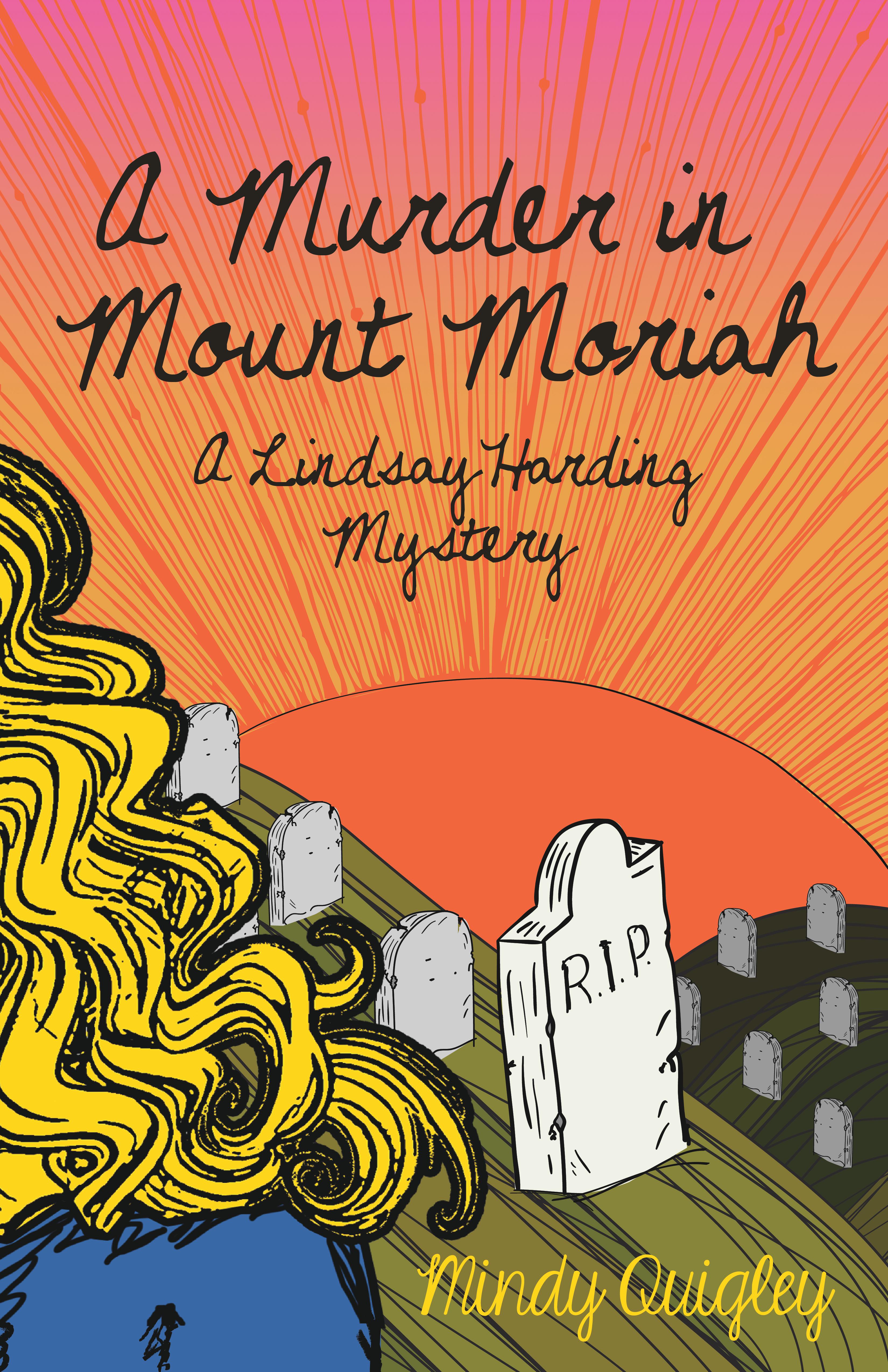


 Minty Fresh Mysteries (MFM): I love your protagonist’s profession–food and crime scene photographer–partly because it’s plausible that she would actually have access to information about murders. It drives me nuts when, say, a glassblower or a pastry chef or


 Who, you ask, is that fancy person sitting on Amazon’s bestseller charts at Number 12 alongside Janet Evanovich and J.K. Rowling (writing as Robert Galbraith)? Why it’s lil’ old me, with my BESTSELLING novel