With the launch of my latest Deep Dish Mystery, Sleep in Heavenly Pizza, I’ve been getting ready to trot out Ye Olde Dog and Pony Show once again. I’ve observed previously that being a professional writer is essentially running a small business. Things like creating social media content, preparing for events, doing my taxes, and tending to relationships with booksellers, editors, bloggers, and readers—are necessary parts of the job. A lot of writers especially hate the task of pimping a new release, figuring out ways to get it on readers’ radar screens without looking like a shameless huckster.
I get it. For some writers, doing publicity smacks of lacking writerly integrity. Surely, James Joyce would never do an Instagram reel where he pretended to be several different varieties of cheese??? For many others, promoting your work feels too much like promoting yourself, which can be a terrifying prospect. Writers are often sensitive, introspective, and introverted, qualities that are at odds with the demands of publicity.
Can I tell you something?
<<looks from side to side>>
<<lowers voice>>
I actually like doing publicity.
Yes, sometimes promotion feels like time stolen from the actual writing. But mostly, I regard it as a welcome break, a chance to build my creative muscles in a different way. Plus, as my sisters will surely aver, I’ve always been an attention-hogging ham (aka middle child) and almost nothing embarrasses me. Thus, I will gladly enlist every resource at my disposal in the service of getting the word out. Puppies, adorable children–it’s all fair game.
All this is to say that I was delighted to appear recently on the Midwest Writers Room podcast for an episode of Chapter Break and do funny character voices. I hope you enjoy it!
Here’s a little taste of that. You can click the link above to read more.
Most likely to be an agent of chaos?
Butterball the cat! This chonky orange mischief-maker is a staple in every book. Whether he’s knocking over crucial evidence in SIX FEET DEEP DISH or unexpectedly leading the way to a clue in ASHES TO ASHES, CRUST TO CRUST, Butterball’s accidental heroism is legendary. Just don’t be fooled—his real priorities are snacks and snuggles, solving murders is just a side gig.
Thanks for reading. Now it’s time for me to harness the dogs and ponies (and adorable children), because we’ve got more shillin’ to do!
If you write for a traditional publisher, you get paid twice a year. That payment covers a period that’s up to twelve months prior to the date of the check. The sales are lumped together in various line items, some illuminating (e.g. Canadian e-book sales), some… less so (I’m looking at you “Additional Earnings” line item).
So yeah, you may be wondering what LSD-dosing psychopath invented such an arcane business model. And you may find yourself asking why any self-respecting literary artiste such as moi would put herself through it all. Maybe for the fame and fortune?
Overall, there’s almost no way to track whether a specific promotion/appearance/snippet of media coverage had a measurable effect on sales.*
*Unless you obsessively track your Amazon rankings and Nielsen Bookscan numbers and try to extrapolate your weekly sales numbers from there. Which I for sure don’t do on a regular basis. ‘Cuz that would be batshit crazy. <<deletes browser history>> 😬
I, like most of my writerly brethren, have zero job security and little understanding of how to make this modestly-profitable hobby/poorly-remunerated career work for me. I end up saying “yes” to almost every marketing opportunity, constantly afraid that I’m not doing enough, that my next project will implode like a billionaires’ submarine. Thus, over the past few years, I’ve found myself running on a relentless hamster wheel of social media posts, guest blogs, newsletter articles, giveaways, and appearances, trying to find success. I live in fear that the Spigot of Modest Recognition could, without warning, stop dribbling out the little droplets of validation that sustain me.
And that’s because I’m lucky enough to be afforded those opportunities. I have a series of mass market paperbacks with a Big Five publisher. They sell, if not like hotcakes, at least like very warm cakes. I’m well aware that not every writer is so fortunate. So I also get to feel guilty for being ungrateful! Yay! The shame cherry on my fear sundae!
For several years, I’ve been burning the candle at both ends, trying to justify this career choice. And, inevitably, I have a mini-existential crisis whenever a new book comes out or a major deadline looms or my royalty check comes in lower than I expected it to. I’ve been living in a constant state of low-grade existential panic.
A few things have happened over the past couple months that caused me to start to recalibrate. My beloved grandmother, the bedrock of our family, died. My entire nuclear family got sick, some of us more than once. My aunt was struck by a car and nearly killed on the front steps of the post office. (Yes, you read that right. A car went out of control and up a flight of stairs.) I’m realizing that all the career-related, mini existential crises were just a prelude to the real deal.
It got me asking myself why I do this writing thing. Here’s what I came up with:
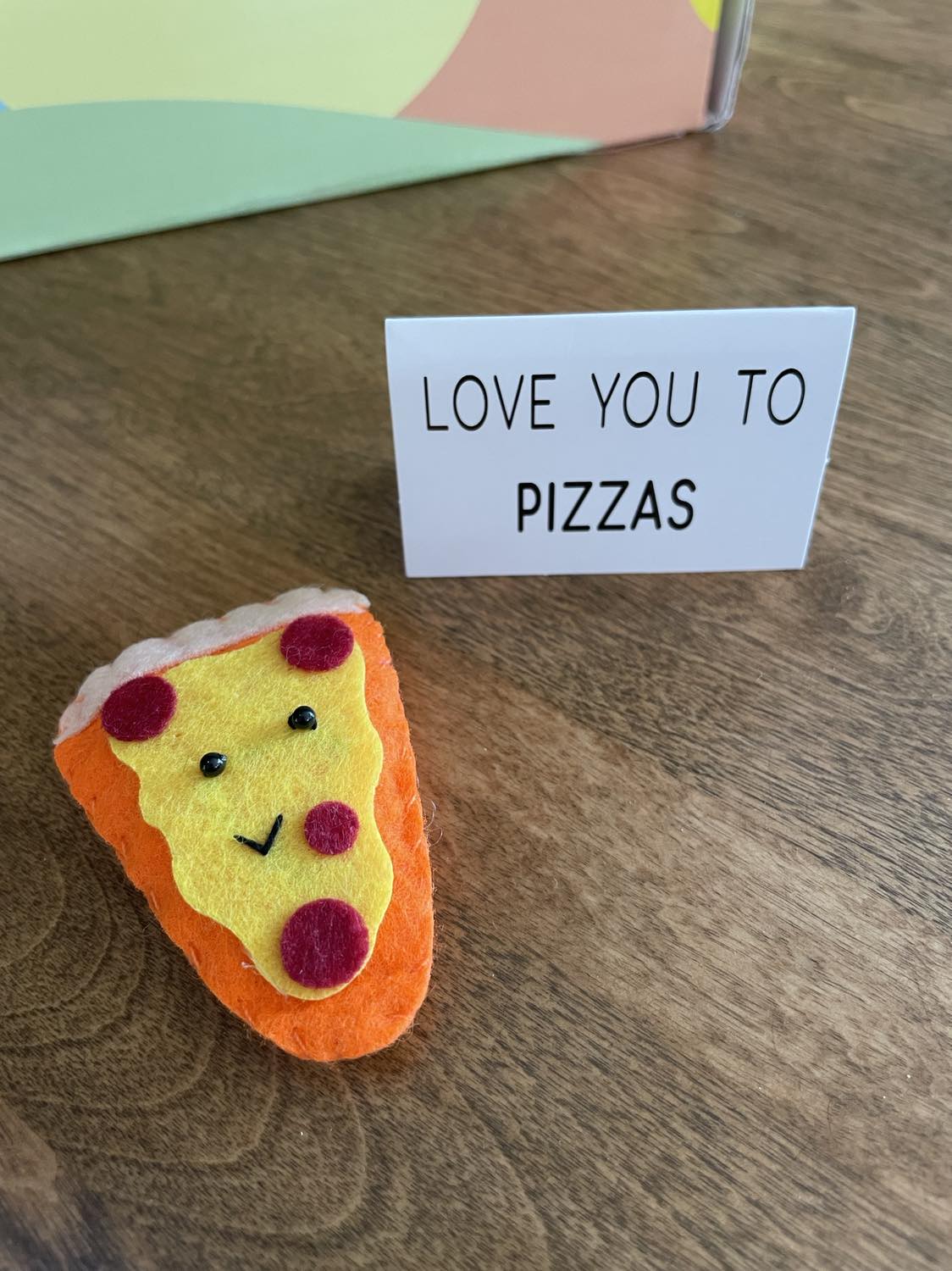
A “pizza” the gift box my friend Desiree sent to me.
This little pizza friend was part of a cheer-up gift box my friend Desiree Di Fabio sent to me recently. Desiree and I, along with fellow mystery writer Korina Moss, bonded over cheese fondue during last year’s Mechanicsburg Mystery Book Fete. I’d never met Desiree before that event, but we had an instant connection. That happens a lot in the mystery writing world. You’ve spent your whole life searching and suddenly HERE ARE YOUR PEOPLE.
Maybe in school, you were the only weird kid reading a book during outdoor recess. Maybe, while your high school classmates were out doing whatever normal high schoolers do (drugs, probably? IDK), you were that nerdy teenager the public librarians all knew by name. Maybe you were that oddball who spent decades wondering if other people thought about death as much as you do. Welcome, my friend. The world of crime fiction is your happy place.
My life is infinitely richer because I have written and published my books and stories. The community of readers and writers I am a part of is wonderful. Telling stories is a joy and a privilege. Through this work, I learn so much about myself and what it means to be human. Also, I FREAKING LOVE WORDS. They are so powerful.
I’m still in the midst of a pretty rough season of life. But when I look at this fuzzy little pizza, I’m reminded of the joys of my life as a writer. Joys that cannot be quantified on any bestseller list or with a six-figure check. Pleasures that defy external metrics. When it comes to a full creative life and sustaining personal relationships, I am very rich indeed.
Those familiar with Game of Thrones will recognize the hallmarks of “grimdark” storytelling. In a grimdark world, morals are flexible. Dark aesthetics and gritty details dominate. Today’s hero could be tomorrow’s villain, if external circumstances change. Given the headlines of the past few years, the moral uncertainty of such stories has a “ripped from the headlines” feel that seems appropriate for our chaotic era.
On their face, grimdarks are everything cozy mysteries are not. Grimdarks are gritty and explicit where cozies are saccharine and romanticized. Cozies are fluffy and escapist. Grimdarks are meaty, heavy, real.
But the more time I spend reading and writing cozies, the more I think of them as tools for confronting, and reckoning with, the same (un)ethical landscapes as grimdarks. Even as I type this, I can hear the distant sizzle of frying synapses as readers try to suss out what a cozy mystery stalwart like bakery owner Hannah Swensen has in common with #teamgrimdark soldier of fortune Jamie Lannister, other than perhaps Nordic good looks and an intense love for their sisters.
My dog died yesterday. There is no silver lining to this. She was my beloved. My sweetest, goodest, irreplaceable baby girl. And now she’s gone.
Peggy was eleven, which isn’t tragically young. Her death, after months of worsening health, was as good as a death can be–peaceful, painless, at home, surrounded by her family.
But she’s dead.
In my day job in the clinical trials office at Virginia Tech’s vet school, I have a lot of end of life conversations. Over the past few weeks, I’ve been telling myself all the things I tell other pet owners. “You’re doing the right thing.” “We are blessed to be able to offer pets a way to end their lives with dignity and compassion.” “Your pet is lucky to have an owner who puts their comfort and happiness above all else.” I say these things to others because I know that words matter. The right words shape our darkest, heaviest pain. They scaffold feelings and fears. Sometimes they give us ways of thinking that help us to snatch a scrap of meaning from the pile of tornado-spun ruins that used to be our hearts.
I was talking to a colleague recently about why I write. I sometimes joke with other writers that I do it for the money, and then we laugh until we cry. There are maybe a dozen people alive who’ve gotten rich by stringing words together, and we are not them. I’d get better ROI from selling my blood plasma. So why do I do it? And why, in particular, do I churn out formulaic comfort reads about, of all things, murder?
As I clung to my little heart scraps in the wake of the emotional calamity of my dog’s death, my reasons came into focus. Part of why I write is because meaning-making is what I feel compelled to do as a human. Everything alive will die, but only humans, and maybe some really emo chimpanzees, actually seem to be aware of this fact. Death fills us with awe and dread. I can’t even begin to fathom it. It is obvious, basic, and mundane, but it’s also too large and bewildering for my puny brain to hold. Death is the ur-Bogeyman, the OG unknowable unknown.
When I write a murder mystery, I can put guardrails on death. I can ensure that the mystery of (the fictional) death is solved and that wrongdoing is dragged into the daylight and wrongdoers are brought to justice. Isn’t that what humans have always used stories for? We take something that makes no sense and build a framework of explanation for it. Word by word, we give it shape. We constrain its scope. We nail it to the wall to be studied. It doesn’t make the bad thing any less bad. A turd in a frame is still a turd. But maybe we can take that turd, put it in a better frame, on a bigger wall where it really catches the light.
I wrote an obituary for my dog the day before she died, knowing that there’d be zero chance I’d have the wherewithal to do it afterward. I wrote it because I knew that telling the story of who she was and what she meant to our family would be important.
Words are not resurrection spells. I wish they were. But in the face of the world’s unfathomable mysteries, in the aching absence of warm, furry cuddles, words give us something to hold.
Peggy Lymm Quigley returned to the light on October 16, 2023, dying peacefully at home, surrounded by her family.
Peggy was born on February 10, 2012 in the quaint English village of Lymm. The family she was born into had named all the other puppies in the litter, but her, they simply called Quiet No Name. She had a sweet and passive disposition, preferring to let her littermates take center stage. When the Quigley Family was given pick of the litter, they knew that this sensitive soul would be the perfect fit for them.
Peggy lived the first year and a half of her life in Edinburgh, Scotland, exploring the city and hanging out in dog-friendly pubs. She especially loved jaunts up Blackford Hill with her father and human sister. From up there, Peggy’s beard could blow majestically in the breeze as she took in views of Edinburgh Castle, Arthur’s Seat, and the Firth of Forth.
Peggy took it in her stride when the family relocated to America in August 2013, making the transatlantic crossing in her usual no-fuss style. She developed a reputation as a sweet and friendly neighborhood fixture, who went on occasional sprees to visit her friends. At Virginia Tech, Peggy trained as a therapy dog, doling out cuddles to stressed students during exam weeks.
When her little brother was born, Peggy again rolled with the changing family circumstances, gently tolerating his clumsy pets and wild games. “Giggy” was one of his first words, and he christened his most beloved stuffed toy “Giggy” in her honor.
Peggy enjoyed walks in the cool weather, pouncing on the snow, chasing waves, and lying quietly in the sun. Most of all, she loved cuddles. Peggy poured her boundless love on everyone who crossed her path, and was loved in return, especially by her extended family. Her mother Mindy was her closest companion. During the Covid lockdowns and every day since, Peggy could be found quietly snoozing under Mindy’s desk chair.
Peggy, we wish you could’ve stayed with us longer. You gave everything and demanded nothing. You loved bountifully and unconditionally, and were loved in return. Your heart was the purest gold.
You’ve written a great first novel. There’s buzz! There’s praise! The book is flying off bookstore shelves. Even the notoriously finicky and hot-blooded reviewers on Goodreads adore it. They’re throwing stars at you like henchmen in a ninja movie. Your publisher loves the book so much in fact, that they want you to write another one.
Pronto.
Welcome to the Land of the Sophomore Slump.
Many writers spend years crafting their first book in a headspace that’s blissfully free from deadlines, contracts, and fan expectations. Then, when their debut novel is (miracle of miracles!) successful, they’re expected to crank out the next book in the series in record time–often less than a year if they’re writing a mystery series. The pressure to live up to expectations has gotten the better of many an author. Even Harper Lee, who penned what is routinely ranked among the greatest American novels of all time, struggled to repeat To Kill a Mockingbird’s success.
My second book, Ashes to Ashes, Crust to Crust, came out earlier this year, but I had a fortunate turn of fate that kept me from facing the usual pressures that portend the Sophomore Slump. The pandemic delayed my contract and thus pushed back the release of my Deep Dish Mystery Series, which meant that I was able to finish books two and three before the first book even came out. Now that I’m working on book four in the series, though, I’m doing my best to guard against Senioritis!
My own experience leaves me even more impressed when a fellow author manages to pull off a series that improves with each new outing. Forget mere whodunnits, these next-in-the-series reads are truly next-level.
Pop on over to Crime Reads to check out my list of Seven Sophomore Slays that’ll keep you glued to your Kindle…
My favorite kind of reader feedback is when someone tells me they laughed out loud at something I wrote and scared their dog/spit their soda/made fellow passengers on the subway doubt their sanity.
LOLs are my love language.
So I was especially heartened when Holly Adams, the awesomely talented narrator of my Mount Moriah Mysteries and my Deep Dish Mysteries, sent me this outtake of her recording a scene from Ashes to Ashes, Crust to Crust.
For reference, the dialogue in question involves sous chef Sonya talking to her uncle Avi, an attorney who has come to Geneva Bay to help a friend caught in a sticky situation with the local police. The scene is supposed to read as written below.
“Why did you let her talk?” Sonya said. “You named your dog Miranda, for God’s sake. The only dog in existence named after a constitutional procedure. You always told me not to answer questions if I ever got arrested.”
Avi threw up his hands. “So I’m supposed to tackle your lady friend and stuff a gag in her mouth? I told her to shut her yapper. She didn’t listen to me. Just like your Aunt Ruthie, or little Miranda for that matter. She ate a full tube of your aunt’s red lipstick, did your mom tell you? Now I gotta buy new carpet for the rumpus room.”
Ashes to Ashes, Crust to Crust
I admit that I, too, sometimes get a giggle out of my characters. The reaction is weirdly detached. I don’t feel like I’m chuckling at my own cleverness or patting myself on the back. I’m laughing at this hilarious group of people who happen to be fictional and live inside my head.
My husband walked by my office one day and caught me in the act–alone, laughing at my computer screen. “You won’t believe what Butterball did!” I said, pointing to the Word document. When I set out to write that scene, I had a vague idea of where it was going, but I had no inkling that Butterball the cat, out of nowhere, would decide to pull off some guffaw-worthy acrobatic antics. That scene is near the end of book three in the series, Public Anchovy Number One, which hits bookstore shelves on December 26th. Hope you’ll find it as LOL-able reading as I did writing.
When I’m thinking up a new character for one of books, I tend to give a lot of thought to how the person talks. In the Deep Dish Mysteries, for example, you know that if someone says, “For Pete’s sake…” that’s Wisconsin farmgirl Melody Schacht. And if a character busts out a witty play on words that makes you laugh and groan at the same time, that’ll be straight from the mouth of sous chef/BFF Sonya. I’m also fascinated by accents, especially unusual ones like the dialect of North Carolina’s Outer Banks, which features heavily in A Death in Duck, from my Mount Moriah Mysteries Series.
As I’m inventing this panoply of distinctive voices, I should probably spare a thought for my longtime collaborator, audiobook narrator Holly Adams. Over the years, Holly has gamely voiced whatever characters I’ve thrown her way. From a gravelly old man on his deathbed to a toddler squeaking out her first complete sentences. A lesser narrator might balk, but not Holly. Bulgarian accent? Sure. Mobster with a pro wrestler physique and a hockey mom inflection? Bring it on. I’m lucky to have her talent at my disposal. Holly has previously shared some of her secrets for giving each character a unique voice. But coming up with accents and voices isn’t the only challenge audiobook narrators face.
In addition to cozy mysteries like mine, Holly records a lot of non-fiction and a LOT of fantasy books. It never occurred to me how challenging it is for a narrator to cope with page after page of made-up names and places. Can you imagine being handed a book from the Game of Thrones series and having to say DaenerysTargaryen five times fast? Harder still, in her non-fiction work, she has to cope with real people’s names in languages that she doesn’t natively speak. In those instances, she has to be even more diligent about getting things right, because there are actual people (besides the author) who’ll know if she gets it wrong.
To celebrate the publication of Six Feet Deep Dish, I was invited to write a guest post for the awesome mystery blog, Criminal Element. Read on for more on writing, music, and my uncanny similarity to Olympic gold medal swimmer Michael Phelps.
Before a big race, swimmer Michael Phelps listened to a playlist to amp up his energy, increase his focus, and get in the zone. Maybe you can picture him, headphones on, bopping his chin to a beat that was audible only to him. I’m exactly the same. You heard it here, people. Michael Phelps and I are basically the same person. Except instead of setting world records for a sub-two-minute 100m butterfly and going for gold as the most decorated Olympian of all time, I write novels about a fat cat and pizzas.
The Quigley clan traveled to England over Christmas to see my husband’s family, so our miniature Schnauzer spent the holidays with my parents. She had a fantastic time and gained a mind-boggling amount of weight. Like three pounds in six weeks. That’s about 15-20% of her body mass. Was she running an IV drip of bacon grease? Did she discover a hidden cache of Egg McMuffins buried under my parents’ garage? There will be a future blog post on America’s pet obesity epidemic.
Anyway, when it was time for us to reclaim our dog, my parents kindly offered to meet us halfway between their house and ours. Ten hours separate Blacksburg and Chicago, so I spent some time with Google Maps trying to find a location that would not only be roughly halfway, but also a nice place to spend the New Year’s weekend. I discovered Maysville, Kentucky.
Maysville, Kentucky is cute AF.
Y’all, this town. I’ve traveled extensively in the eastern US and have spent a lot of time in Kentucky over the years. And yet I had never even heard of Maysville — a town so adorable, it makes Hello Kitty look like a mangy old fleabag in comparison. I’m talking quaint storefronts. I’m talking cozy cafés. I’m talking a bustling Main Street, all tarted up for Christmas.
At this point, you may be asking why my writing blog has suddenly become a travel blog. You may be asking if I’ve been paid off by the Maysville Chamber of Commerce. Alas, no, but I do want to use this opportunity to let it be known that I am very amenable to bribery in any form.
There’s not a lot around Maysville. Like if a medieval cartographer drew the area around it, they’d draw some squiggles and a sea monster in that part of the map and call it a day. Maysville, it turns out, benefitted from some fortunate geography, being one of the few Kentucky towns along the Ohio River that could host a steamboat port. That led to it becoming a hub for commerce. Industries, such as wrought iron manufacturing, grew, and the town flourished. Over time, more transport links developed and the town became a regional hub. Somehow, although Americans no longer have a great appetite for steamboat travel or decorative ironmongery, the town has retained its charm.
Which brings me to my writing, and to a town that is near and dear to me: Lake Geneva, Wisconsin. Wisconsin has lakes by the absolute pantsload. You can barely move in that state without squelching your flip-flops into some little swimming hole or another.
Like many working-class kids from the Chicago suburbs, I often spent summer weekends at my friends’ and family members’ lake houses in Wisconsin, passing days tubing, canoeing, and cultivating the kind of radioactive, three-alarm sunburn that was probably outlawed sometime in the late 1990s when parents collectively discovered SPF.
All around Lake Geneva, there are nice little towns with nice little lakes. But if you were visiting, say, the nearby town of Elkhorn, you’d have no idea that you were mere minutes away from a really incredible place. Don’t get me wrong. Elkhorn is lovely. In fact, I got married there. But that part of Wisconsin goes like this: cornfield, little lake, bunch of cows, dinky town, GIGANTIC EFFING MANSIONS AND SPLENDIFEROUS LAKE, cornfield, little lake, bunch of cows*, dinky town, etc. You’re hypnotized by the monotonous repeat loop of cows and corn and then you hit Lake Geneva and Hubba-Waaaah….? Mansions.
In the late nineteenth century, Geneva Lake drew Chicago’s lords of the realm—the Wrigleys, the Schwinns, the Vicks. These folks built straight-up, thirty-guest-bedrooms-and-a-butler-named-Jerome mansions around the lake. Why did they pick that spot? Why did Lake Geneva grow into the same kind of lovely, random pocket of affluence that Maysville, Kentucky did? And what does any of this have to do with my writing?
Stay tuned. I’ll answer these and other burning* questions in my next post…
My short story “Taming the Tiger” will be published in the collection, The Beat of Black Wings: Crime Fiction Inspired by the Songs of Joni Mitchell, later this spring by Untreed Reads. I wrote the story more than a year ago, so it was a little jarring to look back through it as it’s being prepared for publication and realize how dark it is. There is a sinister love triangle, a twisted power struggle, and a Talented Mr. Ripley-style murder. This isn’t the first time I’ve written dark short fiction. In fact, when I started thinking about it, all of my short stories, both published and unpublished, explore disquieting themes and paint bleak pictures of humans and their motivations.
All of this got me wondering: just what kind of monster am I?!
It’s probably common for people to assume that writers match their writing. Ernest Hemingway, whose books center on dashing, macho men battling their inner demons, was a dashing, macho man, battling inner demons. F. Scott Fitzgerald was a Gatsby-like party boy. When asked where his dark inspirations stemmed from, Stephen King had this answer: “People think I must be a strange person. This is not correct. I have the heart of a small boy. It’s in a jar on my desk.” (For the record, King isn’t quite the sicko his books would make him appear, but he was a raging alcoholic for decades, and even now he’s known for being quirky and elusive).
In my case, though, the darkness of my imaginary worlds doesn’t match up with my personality. I’m generally jolly and usually upbeat. I like wiener dog races and the color yellow and pictures of newborn babies wearing giant hair bows. My childhood had the usual share of minor traumas, but I grew up surrounded by loving family members. So why, when I sit down at a computer, does blood and fire pour out of my fingertips?
My fellow mystery writer and good friend, Tracee DeHahn, and I were talking about this phenomenon recently. She, too, is a uniformly upbeat person who comes from a stable background. We’re both relatively new to the world of mystery writing and have been wowed by the kindness and affability of the mystery authors we meet. Seriously, Malice Domestic, the annual gathering of writers who spend their days mentally murdering people, is filled with folks who are, on the whole, kinder than your average church bake sale committee (though, it has to be said, much, much raunchier).
My theory is that for many writers, the page is a safe place to process negative emotions. For me at least, fiction is like an external hard drive to store my darkness. Even cheerful people like me have heaps and heaps of bad thoughts that need to find expression.
Maybe I particularly like to visit those dark places in short fiction because it seems to allow me just enough time to explore those themes without absorbing them. Short fiction is a long weekend in the Land of Id — the raw, exposed, and sometimes downright yucky swamp in my emotional landscape. Visiting Id-Land allows me to appreciate life back at my emotional dwelling place: Giant Baby Bow Town.