You may have heard writers describe moments when their characters take over the story. This has certainly happened to me. I’ll think I know which way a scene needs to go, only to have the folks on the page inform me they have other plans.
Something that gets less attention is what happens when a book’s setting starts taking over the plot.
I certainly didn’t expect Geneva Bay, the charming Wisconsin lakeside resort where my books take place, to start murdering people. But—surprise!—it did just that.
When I first pitched the Deep Dish Mysteries, I had no intention of setting the books in small-town Wisconsin. The books feature deep-dish pizza and a detective descended from Al Capone, so obviously they belonged in Chicago. I envisioned my fictional pizzeria in Hyde Park, where I could draw on the neighborhood’s fascinating history and the city’s unseemly connection with organized crime.
My publisher had other ideas. They loved the concept, but wanted it set in a small, tightly knit community—a place where readers could take a mental vacation.
I tried to argue that Chicago is, in fact, a great place for a vacation, but finally relented, moving the whole shebang to “Geneva Bay,” a lightly-fictionalized version of Lake Geneva.
As it turned out, my publisher had done me a huge favor and the books took a direction none of us could have expected…
For about a decade, I’ve suffered from persistent, sometimes-debilitating insomnia. After many years of strategies, drugs, tinctures, doctors, therapists, etc., I have found a method that (mostly) works to help me sleep. Each night, I’ll read for a bit, then recline on my couch, cuddle up with my dog, put a boring British docuseries on extremely low volume in an otherwise dark room, and watch it until I fall asleep. Then, at some point during the night, I stumble into my bedroom and continue to sleep for whatever hours remain.
Before you start sending me your recipe for homemade sleepytime tea or evangelizing about CBD oil or telling me screens/blue light are disruptive to sleep, allow me to save you the trouble. I’ve tried ALL. THE. THINGS. For me, the bit of nonfiction reading + boring British TV + cozy dog system works as well or better than cognitive behavioral therapy, sleep medications, hypnosis, meditation, strict sleep hygiene, or any of the myriad other remedies I’ve experimented with.
I prefer to read nonfiction before bed, since even cozy fiction tends to engage my writer brain and ramp up my imagination (and my anxiety, if the main character is imperiled).
Here’s where we get to the rabies and canal boats.
One night, I picked up the book I’d been reading—Rabid: A Cultural History of the World’s Most Diabolical Virus, which I will grant you, may not be a common choice for a relaxing bedtime read. I personally enjoy knowing that the subtypes of rabies are called “paralytic” and “furious,” due to the predominant symptoms they produce, and that we all owe a debt of gratitude to Louis Pasteur. Seriously, raise a glass of bacteria-free milk to that guy. What a mensch.
But back to the blog post. The section I read that night discussed rabies subplots in Charlotte Brontë’s novels, wherein the disease serves as a metaphor for various human anxieties about the natural and social worlds. I dimly registered the footnotes, which contained a quote from a woman named Ann Dinsdale, the principal curator of the Brontë Parsonage, former residence of the famous sisters and their less-famous brother.
I closed the rabies book and flipped on one of my favorite fall-asleep docuseries: the program Great Canal Journeys, in which a pair of adorable elderly British thespians (you’ll recognize them if you’ve watched as much Britbox as I have) tootle around Europe’s canal system in a narrowboat, having extremely low-stakes adventures.
In one such episode, hosts Prunella and Tim visit Haworth, a quaint hilltop village in Yorkshire. There, they tour the Brontë Parsonage. Low and freaking behold: they are given a personal tour by none other than Ann Dinsdale.
Twice in the space of an hour, I encountered the curator of a small English house museum—while I was at home in Virginia and decidedly NOT doing any Brontë-related research whatsoever.
The next time a reader complains that a coincidence in one of my books is unrealistic, I will point them to this blog post, or to one I wrote years ago about LBJ’s dog meeting Colonel Sanders.
Full disclosure: I don’t like any of the Brontë’s books, not Jane Eyre, not Wuthering Heights, not the other one that the other sister whose name I can never remember wrote. (Even fuller disclosure: I never read that one by the other sister). However, the Ann Dinsdale Singularity struck me as so delightfully uncanny that I immediately dashed off an email to the museum telling them all about it.
Here’s their reply:
Good morning Mindy,
Thank you for your email and for sharing this anecdote. Our senior curator Ann Dinsdale is often involved with many projects at once, and it’s wonderful to hear how you encountered her work twice in one hour!
We look forward to welcoming you to the Brontë Parsonage Museum in the future.
So, dear reader, I took them at their word. My husband and I made a special detour to Haworth when we were in the area.
Sadly, Ann Dinsdale wasn’t there the day we visited, but we did get to see a handwritten manuscript of Wuthering Heights. The original manuscript’s disappearance is shrouded in mystery, but in 2017 the museum launched a project to have visitors copy out the entire book, one line at a time.
The first entry– “I have just returned from a visit to my landlord” — was written by… Ann Dinsdale.
At Death’s Dough is the only installment of the Deep Dish Mysteries that doesn’t take place entirely in the present day.
The book includes a brief prologue that sweeps readers back 100 years, to the time when the mob held sway in the Windy City and Prohibition was in full swing.
I’m so excited that the audiobook is finally in production — now more readers will be able to catch up on the series in their chosen medium. The book will be out later this summer, but my fabulous narrator, Holly Adams, shared this exclusive sample to wet your whistle.
The long-ago mystery revealed in the prologue comes to the fore later in the book, so listen carefully for clues!
I, like many of my fellow writers, discovered earlier this week that piracy is alive and well in the 21st century.
For most of my writing career, I’ve been on the losing end of the Whack-a-Mole battle against book piracy websites. These sites purport to offer free PDF downloads of popular titles like mine, sometimes framing their criminality as something noble. Here’s the “mission statement” of one such website: “We believe that knowledge and information should be free and accessible to everyone around the globe.“
In reality, though, websites like this aren’t Robin Hood, stealing from “rich” to give to the “poor.” They’re frequently fronts for criminal activity, redirecting the already-meager royalties most writers receive into their own coffers. They distribute malware that turns infected devices into bots for larger criminal operations. They steal and sell user data. Often, they charge users a monthly subscription fee for access to stolen books, essentially fencing copyrighted IP from authors and pocketing the profits.
You know where readers CAN get a lot of free books, including mine? The Freaking Local Library! Digital! Audio! Print! They have it all–for FREE. And if they don’t already carry a book you want, it’s usually just a matter of asking them to order it. (The recent assaults on local library content and funding is a rant for another day.)
Anyway, I’ve come to accept these bottom-feeding pirate sites as the inevitable price of having my work widely available. If readers want to subscribe to fringe websites to get access to cheap/free books, on their own heads be it.
But that uneasy truce was broken last week.
The Atlantic ran an exposé on Meta’s efforts to find well-written prose on which to train their new AI model. Meta employees, apparently, looked into sourcing the material legally, but found their options too “expensive” and inconveniently “slow.” Instead of compensating authors, they decided to hoover up the vast catalog of books available via a piracy site. That’s right. They straight-up stole my entire body of work, along with that of just about every other published author I know.
That’s not even the worst part. This multi-billion dollar company then used my own work to train an AI model whose explicit aim is to replace authors like me.
I actually like generative AI. I’ve already seen the benefits of it in my own life, and I’m excited about what it can do for fields like transportation and healthcare. I’ve recommended it to people – even other writers! – as a useful tool for brainstorming, getting unstuck, and automating tedious tasks. Increasingly though, I feel anxious about how quickly things have spiraled and how unfettered (and seemingly amoral) these companies are. I’m angry that these fat cats of Silicon Valley have stolen something so precious.
For the time being, I’m still using Meta platforms. There are few good alternatives. I hope writing to Meta, as I have done, to express my outrage “as a concerned user and content creator” will carry more weight than me leaving the platforms in a quiet huff. Other actions writers can take are outlined by the Authors Guild.
Meanwhile, though, I’ve started to build a little escape pod: an author mailing list. Starting next month, I’ll be sending out a quarterly newsletter directly to readers. A new marketing and communication channel that isn’t mediated by the mendacious tech bro-ligarchs who just ganked the contents of my heart and soul.*
Please consider joining the email list by entering your email below and pressing the blue Join button:
Processing…
Success! You're on the list.
Whoops! There was an error and we couldn't process your subscription. Please reload the page and try again.
*I’m aware that even my humble MailChimp list is indirectly within the grasping claws of tech giant Intuit. But since hand-delivering written notes to each of my readers seems impractical, this feels like the best option.
With the launch of my latest Deep Dish Mystery, Sleep in Heavenly Pizza, I’ve been getting ready to trot out Ye Olde Dog and Pony Show once again. I’ve observed previously that being a professional writer is essentially running a small business. Things like creating social media content, preparing for events, doing my taxes, and tending to relationships with booksellers, editors, bloggers, and readers—are necessary parts of the job. A lot of writers especially hate the task of pimping a new release, figuring out ways to get it on readers’ radar screens without looking like a shameless huckster.
I get it. For some writers, doing publicity smacks of lacking writerly integrity. Surely, James Joyce would never do an Instagram reel where he pretended to be several different varieties of cheese??? For many others, promoting your work feels too much like promoting yourself, which can be a terrifying prospect. Writers are often sensitive, introspective, and introverted, qualities that are at odds with the demands of publicity.
Can I tell you something?
<<looks from side to side>>
<<lowers voice>>
I actually like doing publicity.
Yes, sometimes promotion feels like time stolen from the actual writing. But mostly, I regard it as a welcome break, a chance to build my creative muscles in a different way. Plus, as my sisters will surely aver, I’ve always been an attention-hogging ham (aka middle child) and almost nothing embarrasses me. Thus, I will gladly enlist every resource at my disposal in the service of getting the word out. Puppies, adorable children–it’s all fair game.
All this is to say that I was delighted to appear recently on the Midwest Writers Room podcast for an episode of Chapter Break and do funny character voices. I hope you enjoy it!
Here’s a little taste of that. You can click the link above to read more.
Most likely to be an agent of chaos?
Butterball the cat! This chonky orange mischief-maker is a staple in every book. Whether he’s knocking over crucial evidence in SIX FEET DEEP DISH or unexpectedly leading the way to a clue in ASHES TO ASHES, CRUST TO CRUST, Butterball’s accidental heroism is legendary. Just don’t be fooled—his real priorities are snacks and snuggles, solving murders is just a side gig.
Thanks for reading. Now it’s time for me to harness the dogs and ponies (and adorable children), because we’ve got more shillin’ to do!
I was interviewed a few weeks ago for writer Tara Laskowski’s blog. In addition to being quick-witted and kind-hearted, Tara is also a master of twisty suspense. Her novels include The Weekend Retreatand The Mother Next Door, which the NYT Book Review called a “polished and entertaining read.” As it happens, Tara herself is also polished and entertaining. She’s won the Agatha Award, the Macavity Award, and the Anthony Award and has been a finalist for a butt-ton of other fancy awards.
And now, on to the interview!
Tara: What is your greatest fear as a writer?
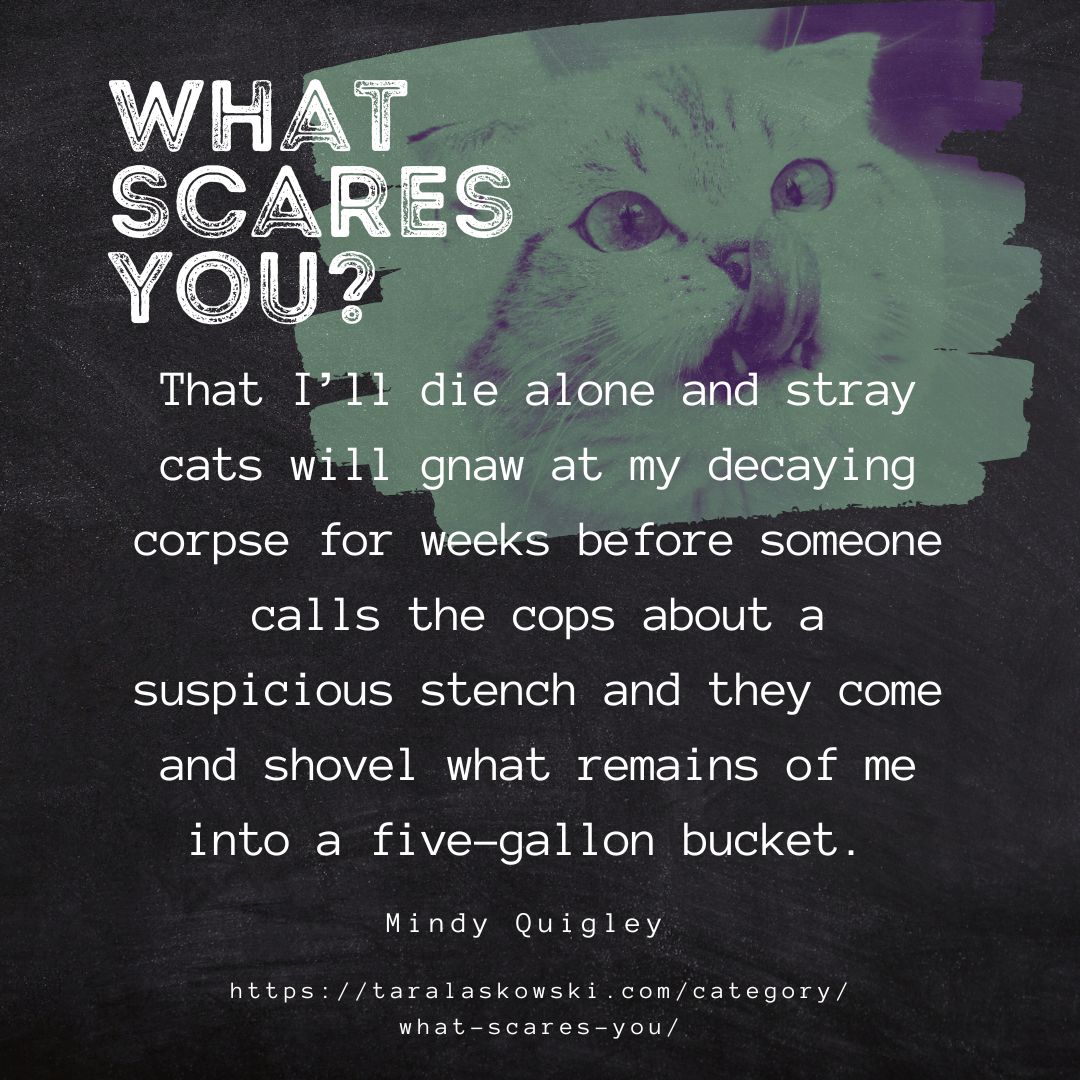
Me: Where to start? That everyone will hate my books. That I’ll become mentally or physically ill and not be able to meet my deadline. That I’ll forget how to write. That I’ll write something that pisses people off and then they’ll hate me. That I’ll be a failure and have wasted my life pursuing this dream. That I’ll be a success and not know how to handle it. That the mild arthritis in my fingers will become debilitating and I won’t be able to type my books. That my poor eyesight will become even worse and I won’t be able to see the computer screen. That I’ll make a stupid mistake in a book and no one at the press will catch it and it’ll go to print that way and everyone will think I’m dumb and careless. That my writing peers will hate my books. That readers will hate my books. That my family will hate my books. That I’ll die alone and stray cats will gnaw at my decaying corpse for weeks before someone calls the cops about a suspicious stench and they come and shovel what remains of me into a five-gallon bucket. Wait, what was the question again?
Tara: What’s your favorite horror movie or television series?
Me: When I was younger, I was obsessed with Dark Shadows. Maybe that’s more of a gothic romance than a pure horror show, though? Anyway it’s got sexy vampires and a governess-wealthy dude romance à la Jane Eyre, and a dual timeline sitch that’s akin to Outlander. BUT DID I MENTION THE SEXY VAMPIRES?
To find out my plans for world domination and learn why I’m careful what I say into a mirror, read the rest of the interview on Tara Laskowski’s “What Scares You” blog!
Earlier this week, I had the pleasure of being interviewed by CanvasRebel Magazine. Read below for my take on Eighties parenting, Norman Lear, and writing lessons learned (and unlearned)….
CR: Mindy, looking forward to hearing all of your stories today. Do you think your parents have had a meaningful impact on you and your journey?
MQ: My childhood spanned the 80s and 90s, when benign neglect was the dominant parenting style. My mom and dad didn’t micromanage my schoolwork or bog me down with organized extra-curriculars. For a good portion of my childhood, they probably didn’t even know where I was.*
That parenting style freed me to read and watch TV for countless hours every day, unfettered by parental expectations. The fact that they worked the kinds of jobs people without college degrees tend to work—secretary, restaurant server, auto parts store manager, etc.—was also a blessing. When it came time for me to get a job, I chose work that interested me, with no fear that my parents would judge my choices and no expectation of making giant sums of money.
*Definitely not climbing into that broken storm drain by Jenny’s house! Nor “borrowing” Christine’s brother’s chinchilla and trying to make it live in a Barbie camper van! Those things for sure didn’t happen.
My favorite kind of reader feedback is when someone tells me they laughed out loud at something I wrote and scared their dog/spit their soda/made fellow passengers on the subway doubt their sanity.
LOLs are my love language.
So I was especially heartened when Holly Adams, the awesomely talented narrator of my Mount Moriah Mysteries and my Deep Dish Mysteries, sent me this outtake of her recording a scene from Ashes to Ashes, Crust to Crust.
For reference, the dialogue in question involves sous chef Sonya talking to her uncle Avi, an attorney who has come to Geneva Bay to help a friend caught in a sticky situation with the local police. The scene is supposed to read as written below.
“Why did you let her talk?” Sonya said. “You named your dog Miranda, for God’s sake. The only dog in existence named after a constitutional procedure. You always told me not to answer questions if I ever got arrested.”
Avi threw up his hands. “So I’m supposed to tackle your lady friend and stuff a gag in her mouth? I told her to shut her yapper. She didn’t listen to me. Just like your Aunt Ruthie, or little Miranda for that matter. She ate a full tube of your aunt’s red lipstick, did your mom tell you? Now I gotta buy new carpet for the rumpus room.”
Ashes to Ashes, Crust to Crust
I admit that I, too, sometimes get a giggle out of my characters. The reaction is weirdly detached. I don’t feel like I’m chuckling at my own cleverness or patting myself on the back. I’m laughing at this hilarious group of people who happen to be fictional and live inside my head.
My husband walked by my office one day and caught me in the act–alone, laughing at my computer screen. “You won’t believe what Butterball did!” I said, pointing to the Word document. When I set out to write that scene, I had a vague idea of where it was going, but I had no inkling that Butterball the cat, out of nowhere, would decide to pull off some guffaw-worthy acrobatic antics. That scene is near the end of book three in the series, Public Anchovy Number One, which hits bookstore shelves on December 26th. Hope you’ll find it as LOL-able reading as I did writing.
When I’m thinking up a new character for one of books, I tend to give a lot of thought to how the person talks. In the Deep Dish Mysteries, for example, you know that if someone says, “For Pete’s sake…” that’s Wisconsin farmgirl Melody Schacht. And if a character busts out a witty play on words that makes you laugh and groan at the same time, that’ll be straight from the mouth of sous chef/BFF Sonya. I’m also fascinated by accents, especially unusual ones like the dialect of North Carolina’s Outer Banks, which features heavily in A Death in Duck, from my Mount Moriah Mysteries Series.
As I’m inventing this panoply of distinctive voices, I should probably spare a thought for my longtime collaborator, audiobook narrator Holly Adams. Over the years, Holly has gamely voiced whatever characters I’ve thrown her way. From a gravelly old man on his deathbed to a toddler squeaking out her first complete sentences. A lesser narrator might balk, but not Holly. Bulgarian accent? Sure. Mobster with a pro wrestler physique and a hockey mom inflection? Bring it on. I’m lucky to have her talent at my disposal. Holly has previously shared some of her secrets for giving each character a unique voice. But coming up with accents and voices isn’t the only challenge audiobook narrators face.
In addition to cozy mysteries like mine, Holly records a lot of non-fiction and a LOT of fantasy books. It never occurred to me how challenging it is for a narrator to cope with page after page of made-up names and places. Can you imagine being handed a book from the Game of Thrones series and having to say DaenerysTargaryen five times fast? Harder still, in her non-fiction work, she has to cope with real people’s names in languages that she doesn’t natively speak. In those instances, she has to be even more diligent about getting things right, because there are actual people (besides the author) who’ll know if she gets it wrong.
A few weeks ago, I sat down on Zoom with the extraordinary actor and performer Holly Adams. Holly has narrated almost 200 audiobooks, including both the Mount Moriah Mysteries and the Deep Dish Mysteries. Holly and I covered a lot of ground during our chat, from the challenges of pronouncing made-up place and character names in epic fantasy novels to ways to subliminally make your audience hold their breath.
I “met” Holly in 2014, when I heard her audition tape for the Audible recording of A Murder in Mount Moriah. You can hear an excerpt of her performance here. Her vibrant personality just zinged out of my computer speakers. There was no question of hiring anyone else once I heard that audition. Everything about that audition tape was great, but one thing that absolutely blew me away was Holly’s ability to give each character an instantly-recognizable way of speaking.
I’ll be posting more soon, but here’s a sneak preview of Holly showing how she moves sound around her mouth to create distinct character voices without changing her accent.